
CBPR+ (Cross-Border Payments and Reporting Plus)
The global migration to SWIFT ISO 20022 is transforming financial messaging standards across banks, payment providers, clearing houses, and financial institutions.
Swift formally retired MT103 and MT202 cross-border messages in November 2025. But for financial institutions, that wasn't the finish line, it was the start of a longer roadmap.
Contingency processing now carries additional charges as of January 2026. By November 2026, unstructured postal addresses will no longer be accepted, making structured data mandatory across CBPR+ messages.
And SWIFT has already scheduled further requirements for November 2027 and 2028, covering case management, message migrations, and more.
For financial institutions, this raises real operational questions: which systems need to change, how much runway is left, and who can help navigate a roadmap that doesn't stop at one deadline.
SWIFT CBPR+ Roadmap
So, what do you need to do to get ready?
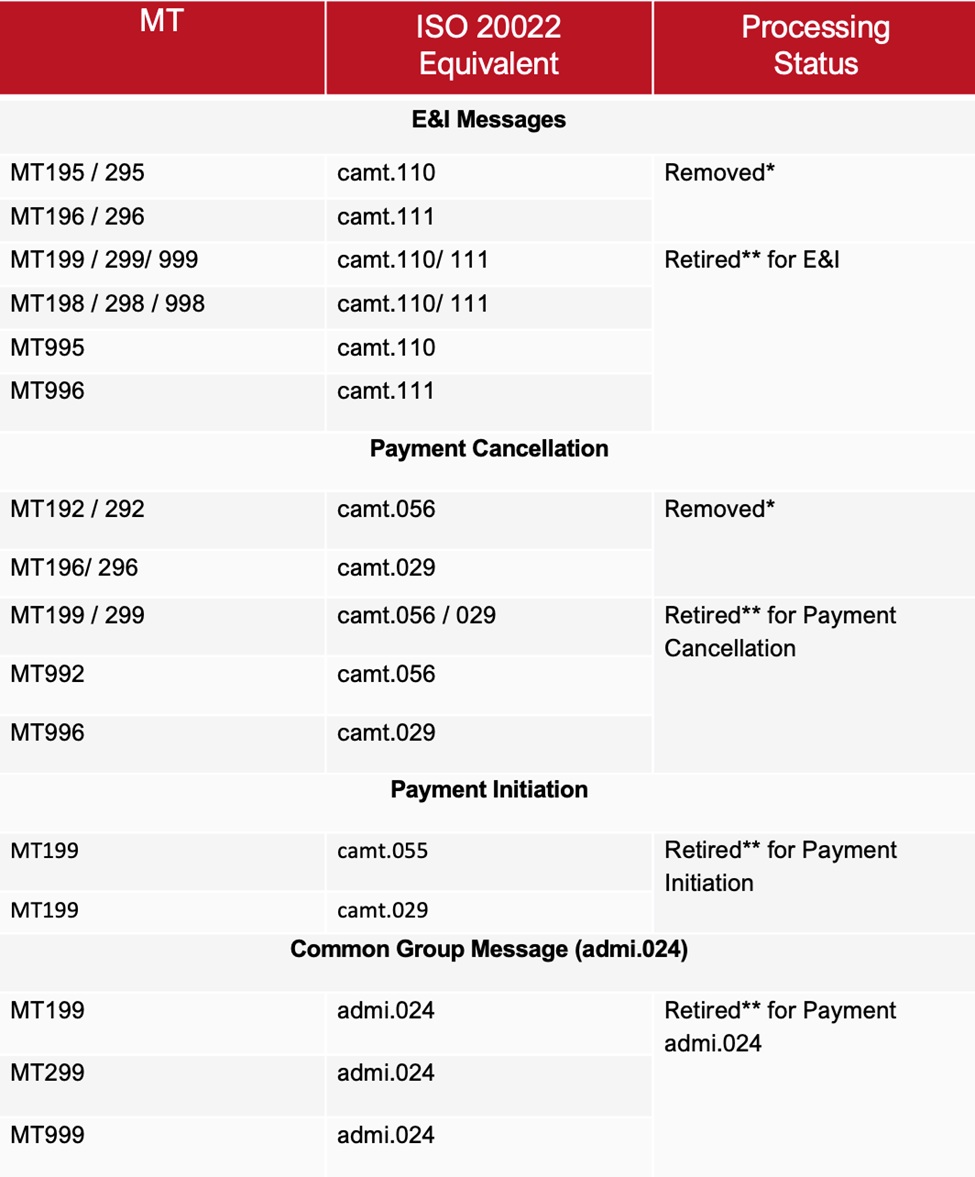
First, implement a case management workflow. That means setting up FINplus Case Management and making sure you can process camt.110, camt.111, camt.056, and camt.029 messages before November 2027.
Then, make sure you have mandatory cancellation messaging set up. You must be ready to exchange payment cancellation messages via Case Management (SRP) over FIN/FINplus by November 2026.
You'll want to map internal workflows. That is, identify and convert all internal E&I processes that rely on MT n95/n96/n98/n99 to ISO 20022 equivalents (these will primarily be camt.110 and camt.111).
Then, you can stop using legacy MTs for E&I. Permanently discontinue the use of MT195/295 and MT199/299/999 for enquiry and investigation purposes.
At this stage, you can move your bilateral/free-format MT199/299 traffic to admi.024. This must be done by November 2027. Swift will run an automatic RMA (Relationship Management Application) bootstrap in November 2026 to enforce mandatory receipt status. In other words, they'll automatically switch on the permissions you need so you can receive the new messages.
You must adopt ancillary messages like pain.002, camt.029, and camt.055 is used in payment initiation and response flows. Align your data models by ensuring message identifiers, case references, and reconciliation logic are aligned with the ISO20022 data model. Update your compliance systems by revising sanctions screening, fraud monitoring, and AML rulesets. And complete bilateral initiation agreements for initiation flows by November 2027.
Down the line? November 2028
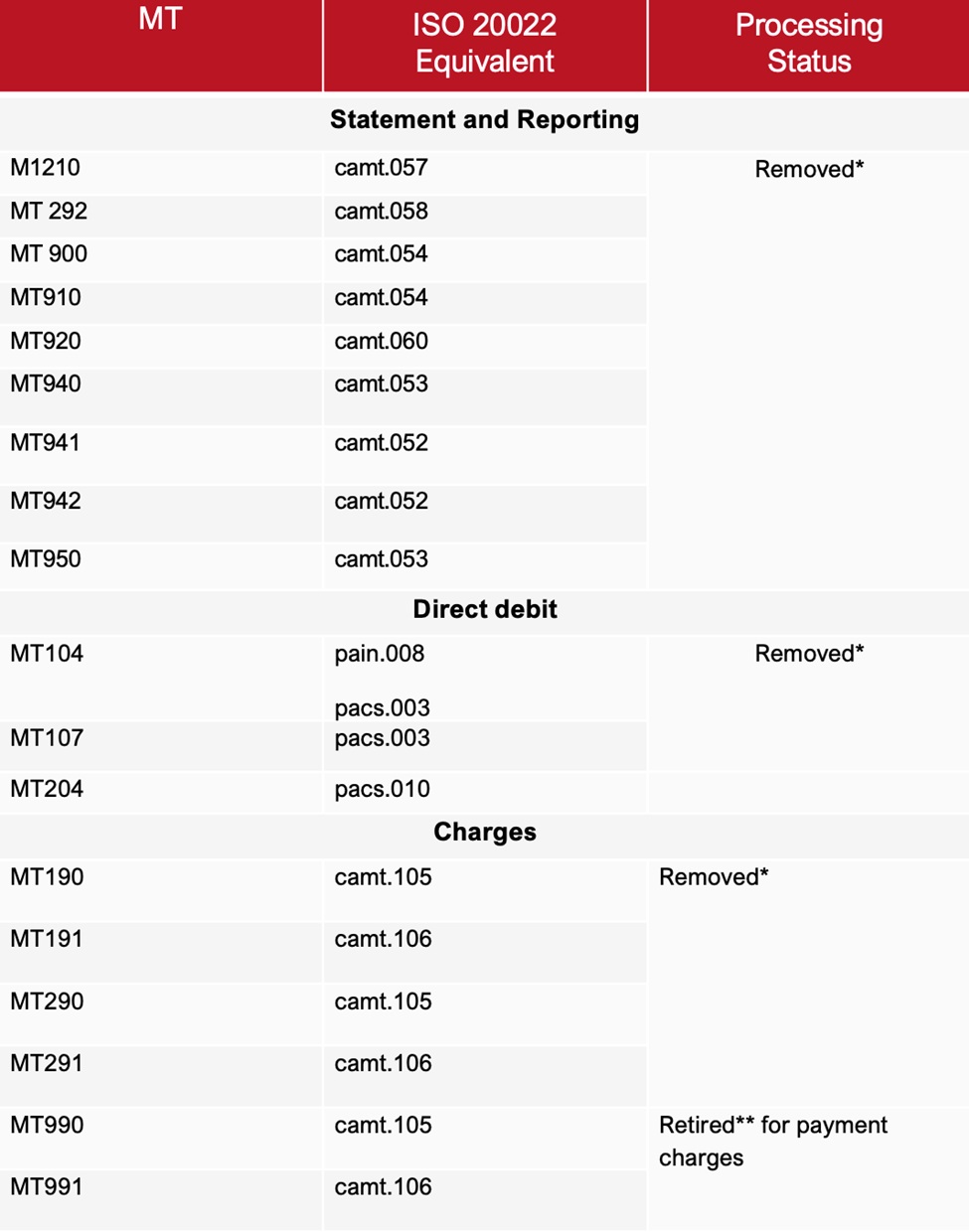
And in 2028? Swift is phasing out MT messages for statements, direct debits and charges and replacing them with ISO 20022 versions between 2027 and 2028. Many MT9xx statement messages (like MT940, MT942, MT950 and MT900/910) will be removed and replaced by camt.052, camt.053, camt.054 and other ISO 20022 formats.
It is important to note: you must be able to receive these ISO messages by November 2027. Swift will not provide MT-to-ISO conversion.
Direct debit messages such as MT104, MT107 and MT204 are also being retired in favor of ISO messages like pain.008, pacs.003 and pacs.010.
And Charges messages (MT190/191/290/291/990/991) will be replaced by camt.105 and camt.106, which provide clearer, structured fee information and support automated reconciliation.
What do you need to do?
Don't wait for 2028. Although the end of coexistence for Statement and Reporting messages is planned for SR 2028, you must be ready to receive these messages in ISO20022 format by November 2027. Swift will automatically bootstrap MT9xx relationships based on traffic, but you must coordinate with your counterparties to align formatting and reconciliation.
Swift will not convert MT9xx messages to ISO20022 camt.xxx formats. Full migration depends on community adoption.
In other words, Swift cannot enforce the end of coexistence until banks adopt ISO 20022 for statement and reporting messages. If you do not migrate, you may still send or expect MT9xx messages, so bilateral processing could continue temporarily (2027 to 2028). Full adoption relies on community readiness, not automatic conversion by Swift.
So, build ISO20022 capabilities. You should develop the ability to generate and reconcile camt.052, camt.053, camt.054, camt.057, camt.060, and camt.058 statements. Format agreements with counterparties should be finalized well before November 2027.
And then plan for the direct debit and charges migration. You must track the development of camt.106 (expected in SR 2026) and schedule migration projects for direct-debit, margin-collection, and charges messages to be completed by SR 2028.
A long road ahead
So there you have it. The end of coexistence is by no means the end of your ISO 20022 migration.
As the CBPR+ roadmap rolls out, you must treat the coming years as a countdown. Retirement dates are now defined for nearly all MT message types. The margin for delay is shrinking.
Success will depend on early engagement with everyone around you. Many of these transitions rely on bilateral agreements rather than enforced network changes.
The clock is ticking. Do not wait for the deadlines. If you haven't started by now, you're already behind.
Talk to us now!
Challenges faced by SWIFT ISO20022 Migration
- Legacy system incompatibility
- Complex message transformation requirements
- Regulatory pressure and deadlines
- Testing and certification demands
- Operational continuity risks
- Resource and expertise shortages
About IFIS
Core Competencies:
- SWIFT ISO 20022 solutions
- Financial messaging systems
- Banking middleware and APIs
- Core banking integrations
- Compliance and regulatory technology
- Cloud-native financial applications
- Enterprise modernization
Our offerings:
- SWIFT ISO 20022 Consulting and Assessment
- SWIFT ISO 20022 Sofware Development
- System Integration Services
- Testing and Compliance Support
- Managed Support and Maintenance
Why Financial Institutions should choose IFIS
Banking Domain Expertise
We understand the operational, regulatory, and security requirements unique to financial Institutions.
Specialized SWIFT ISO 20022 Knowledge
Our team focuses specifically on financial messaging transformation and payment modernization.
Security & Compliance Focus
Solutions are designed with enterprise-grade security, auditability, and compliance standards.
Flexible Engagement Models:
- Project-based delivery
- Dedicated development teams
- Staff augmentation
- Managed services
Client-Centric Delivery
We align technical implementation with business objectives and operational priorities.
Benefits of working with IFIS
- Accelerated SWIFT ISO 20022 readiness
- Reduced migration risk
- Enhanced operational efficiency
- Stronger regulatory compliance
- Future-ready payment infrastructure
- Lower long-term maintenance cost
Download CBPR+ brochure here:
Free Download
Contact us today to schedule a no-obligation 30 minutes Migration Assessment Session